
Loading…
11 September 2026
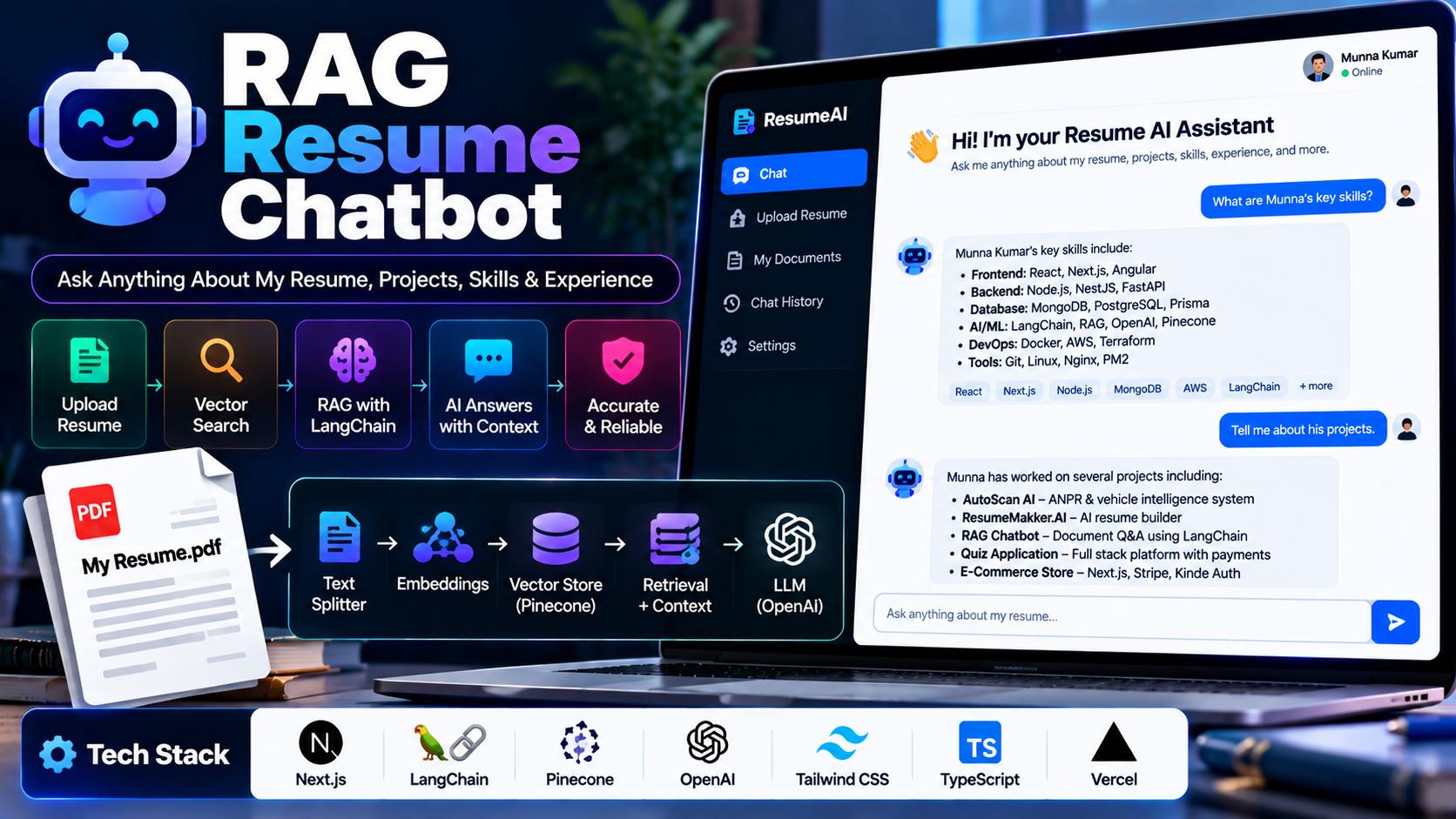
A RAG chatbot sounds simple in a diagram: embed some documents, search them, feed the results to an LLM. In practice, every one of those steps has a decision buried in it that determines whether the bot actually answers correctly or confidently makes something up — and this project exists to work through those decisions on a real, deployed system rather than a notebook demo.
The bot's job: answer questions about my own portfolio — projects, skills, background — grounded in the actual site content instead of the model's general training knowledge.
How you split source content into chunks determines what the retriever can even find. Chunks too large dilute relevance (a match buried in mostly-irrelevant text still gets retrieved and confuses the model); chunks too small lose context (a fragment with no surrounding information the model needs to answer well). The chunking strategy here is tuned to the shape of the actual content — project descriptions and blog posts — rather than a generic fixed-size splitter applied blindly.
Each chunk gets embedded and stored in Pinecone, which handles the approximate-nearest-neighbor search at query time. When a question comes in, it's embedded the same way, and the top-matching chunks come back as retrieval context — this is the "retrieval" half of retrieval-augmented generation, and its quality caps how good the generation half can possibly be, no matter how good the LLM is downstream.
LangChain handles the orchestration layer — taking the retrieved chunks, assembling them into a prompt with the user's question, and calling OpenAI's API to generate the response. The retrieved context is explicitly there to ground the answer, which is what separates this from a bot that just hallucinates plausible-sounding facts about projects that don't exist.
Responses stream token-by-token to the frontend rather than waiting for the full generation to complete before showing anything — which matters more for perceived latency than actual latency; a RAG pipeline with retrieval + generation can easily take several seconds, and streaming is what keeps that from feeling broken.
A static FAQ can't handle a question phrased differently than expected. RAG lets the same underlying content (project descriptions, blog posts) answer arbitrarily-phrased questions without needing every possible phrasing pre-written — the tradeoff is the engineering complexity of chunking, retrieval quality, and grounding that this project works through directly.
FAQ
Pinecone for vector storage and approximate-nearest-neighbor search, with LangChain orchestrating retrieval and OpenAI handling generation.