11 September 2026
Building a 3D DSA Visualizer That Actually Makes Algorithms Click
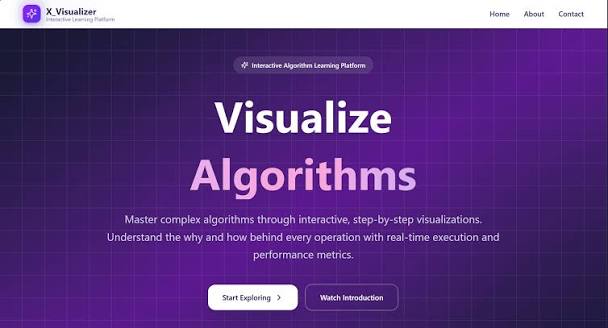
Most students learn DSA the same painful way: staring at static diagrams in a PDF, trying to imagine how a binary search tree rebalances itself or how Dijkstra's algorithm actually explores a graph. I built the Interactive DSA Visualizer to fix that — a real-time 3D engine that turns 110+ algorithms into spatial, animated simulations instead of frozen pictures.
Why 3D, not just 2D animation
A flat 2D animation still asks your brain to do translation work — you're watching shapes move and mentally mapping that to memory addresses and pointers. In 3D, structures like linked lists and binary trees get actual depth and orientation, which mirrors how most of us picture them in our heads to begin with. Arrays become height-interpolated "cyber pillars" where comparisons light up yellow, swaps flash neon red, and settled elements lock in emerald green — so a sort isn't just "numbers moving," it's a sequence of visibly distinct operations.
What's actually under the hood
The engine synchronizes three things in real time: the 3D scene, line-by-line Python code execution, and synthesized audio cues for each operation. That sync is the hard part — it's easy to animate a swap, it's much harder to make the animation, the highlighted code line, and the sound effect land on the exact same frame, every time, across dozens of different algorithm types.
A few structures get special treatment:
- Linked Lists — compact dual-compartment nodes (
[value | next]) connected by cyan laser-pointer lines, with a clearØfor null termination. - Binary Trees & BSTs — spherical nodes that auto-center and elevate as the tree grows, with glowing branch lines tracing the active search path and floating status badges (
FOUND,INSERT,LCA,SUCCESSOR) so you know exactly what state the algorithm is in. - Stacks & Queues — stacks get gravity-based vertical trays; queues get horizontal FIFO conduits — so push/pop and enqueue/dequeue feel mechanically different, the way they actually are.
Who it's for
It's built for the audience that actually needs this most: students prepping for GATE, engineers grinding interview prep, and — since I also teach on YouTube — short-form coding reels (9:16) as well as a full desktop studio mode (16:9), so the same visualizations work whether you're scrolling a reel or following along in a live class.
How the pieces fit together
| Layer | Technology | What it handles |
|---|---|---|
| Rendering & animation state | TypeScript | 3D scene logic, transforms, and timing |
| Algorithm execution | Python | Line-by-line execution driving each step |
| Interactivity | JavaScript | Input handling and UI glue |
| Visual theming | CSS | The cyberpunk-style neon look |
The hardest engineering problem here isn't rendering 3D shapes — it's keeping the animation, the highlighted code line, and the sound effect perfectly in sync on every single frame.
Built with TypeScript, Python, and vanilla JS/CSS for the rendering layer. Full source is on GitHub if you want to see how the sync layer works.
FAQ
Common Questions
Yes — it's public on GitHub, linked above. Feel free to explore it or fork it.